

Inclement weather conditions—rain, fog, snow, and strong sunlight—can present significant visibility challenges for drivers. Clearly, seeing traffic lights in these conditions can mean the difference between a safe stop and an accident.
Many lights struggle in these conditions because their light is susceptible to damage from moisture and glare. However, modern LED traffic signal technology offers clearer illumination, consistent brightness, and advanced optical design, ensuring excellent visibility even in the most adverse weather conditions.
High Luminance and Focused Light Output
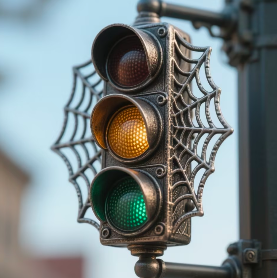
The most significant advantage of LED traffic signals is their brightness. LEDs emit highly concentrated light. Rather than radiating it in all directions, they focus the beam forward, ensuring that most of the light reaches drivers directly.
This directional output is particularly important when visibility is less than 100 meters, as it helps drivers more quickly identify signal colors. Modern signal lenses use optical lens designs that increase brightness without increasing energy consumption. This makes LED traffic signals both powerful and efficient, improving safety while saving energy.
Consistent Color Recognition
In inclement weather, color discrimination becomes even more challenging, especially as many lights fade or change hue over time.
LED traffic signals address this issue by emitting pure, vibrant red, yellow, and green without relying on external filters.
- Unlike traffic lights that rely on tinted glass lenses, LEDs emit light at specific wavelengths, ensuring consistent color visibility in all conditions.
- Even in fog or strong sunlight, colors remain clear and accurate, making them easy to read.
- This consistent color quality ensures drivers can make the right decisions immediately, reducing hesitation and confusion in adverse weather conditions.
Instant Illumination and Fast Response
Every millisecond counts on the road, particularly in bad weather when reaction times naturally slow. LED traffic signals illuminate instantly, reaching full brightness the moment they are powered on.
The quick response of LED lights also prevents “ghosting” effects—when drivers see a faint afterglow from an old bulb and misinterpret it as a signal. With LEDs, light output stops immediately when turned off, giving drivers clear, unambiguous cues.
Automatic Brightness Adjustment
Too much brightness can be just as problematic as too little, especially in heavy rain or snow when reflected light can cause glare. Many LED traffic signal systems now feature automatic brightness control using ambient light sensors. These sensors detect current light conditions and adjust output levels accordingly.
During bright daylight, the signals increase in intensity to remain visible; at night or in dense fog, they reduce brightness to minimize glare. This automatic adjustment maintains optimal visibility while preventing driver discomfort. The result is safer, more consistent communication between the road and the driver, regardless of the weather.
Advanced Optical Lens Design
Another reason LED traffic signals excel in poor weather is their advanced optical engineering. Each LED module is paired with precision lenses that direct light into a defined cone angle. This ensures that signals are bright within the driver’s line of sight but not excessively dispersed.
In fog, snow, or rain, this focused light cuts through airborne particles rather than scattering off them, allowing drivers to see signals clearly from greater distances. Some newer designs even incorporate anti-fog coatings and moisture-resistant housings to maintain lens clarity under humid or freezing conditions.
Together, these innovations make LED traffic signals extremely effective in maintaining visual accuracy when visibility is at its worst.
Reduced Reflection and Glare
LED traffic signals direct most of their light forward in a narrow beam.
- This reduces unwanted reflections, allowing drivers to more accurately perceive the signal color, even in head-on rain or fog.
Additionally, the LED’s crisp color definition ensures that the light is less easily scattered by atmospheric moisture.
- Drivers are able to clearly see the light source and react accordingly, which is crucial at highway intersections or road sections where visibility changes rapidly.
Durability in Harsh Environments
Visibility also depends on reliability—lights that fail in bad weather create dangerous situations. LED traffic signals are sealed against water, dust, and corrosion.
Their housings are typically made of durable polycarbonate or aluminum with IP65 or higher weatherproof ratings. This design prevents moisture from entering the module and fogging up the lens.
In regions with heavy snowfall or temperature fluctuations, some LED systems even include heating elements that prevent ice buildup on the lens. This ensures that the signal remains visible and operational year-round, no matter how extreme the conditions become.
Conclusion
By combining optical precision with energy efficiency and resilience, the LED traffic signal has become an essential tool for maintaining clear communication between traffic control systems and drivers.
0