

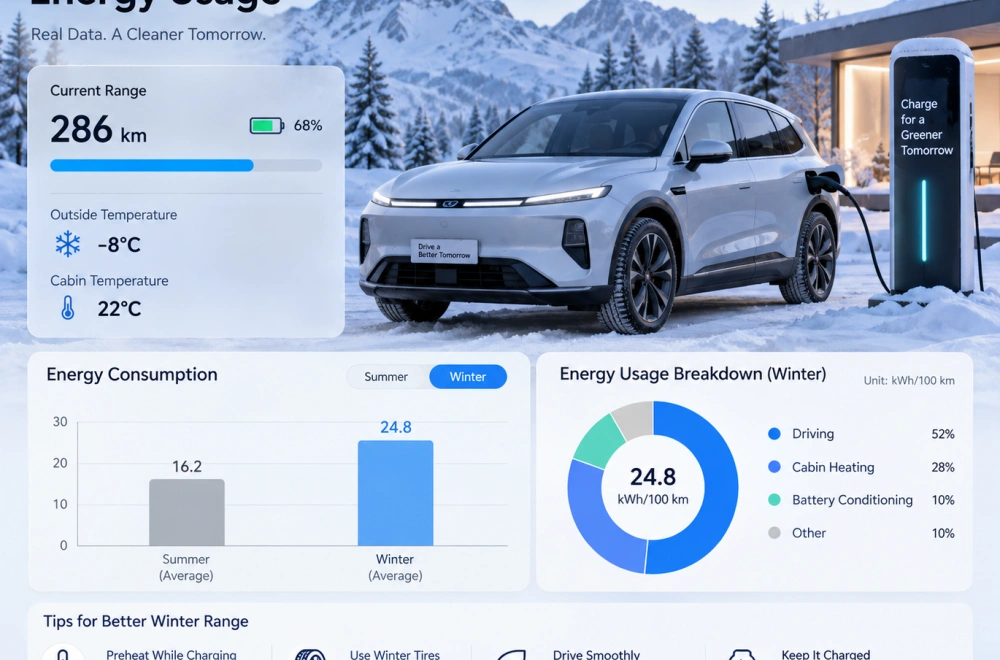
One of the most obvious differences during the use of electric vehicles (EVs) in winter is the low driving range. For example, some routes that can be done with ease during the warm period will require an additional charging session when the temperature approaches zero degrees Celsius or below.
It does not always mean that your EV battery loses its capacity. Low temperatures slow down the electrochemical processes of lithium-ion batteries. On top of that, there is a need for additional energy to heat up both the battery and the passenger compartment of the vehicle. The winter range of your car will depend on battery temperature, heating of the passenger cabin, driving speed, route length, tire pressure, and weather.
Lithium-ion batteries perform better at average temperatures. When the temperature decreases from about 20–25 degrees Celsius to 0 and even -10 degrees Celsius, the resistance increases. This makes ion transfer less effective. Thus, the vehicle needs additional power to maintain optimal temperature conditions.
1. Why Does Cabin Heating Reduce the Winter Range of Electric Vehicles?
Electric Cars cannot depend on engine waste heat.
Waste heat is created in gas-powered cars via combustion, and some of this waste heat can be utilized for heating the passenger compartment.
In EVs, however, motors are highly efficient and create very little waste heat. Thus, in a cold environment, battery energy will have to sustain multiple needs: Battery Energy = Vehicle Movement + Cabin Heating + Battery Heating + Electronics
The more energy needed to provide heating, the less will be left to drive the vehicle.
How Much Energy Can Cabin Heating Use?
A resistance heating system might consume several kilowatt-hours of energy.
Let us say that the heat output of the system amounts to an average of 4 kW per hour: 4 kW x 1 hr = 4 kWh
If the EV requires 18 kWh per 100 km, then 4 kWh equates to: 4 ÷ 18 × 100 ≈ 22 km
It does not necessarily imply that using the heating system drains exactly 22 kilometers of battery life.
Why Does a Heat Pump Help?
In many modern electric cars, there is a heat pump instead of heating with a purely resistive heater.
The operation of the heat pump involves moving the heat using electricity, not creating it from scratch. Its effectiveness can be represented in terms of COP (Coefficient of Performance).
For instance, with a COP of 2.5, it is possible to move up to 2.5 kWh of heat by consuming 1 kWh of electricity.
Nevertheless, heat pump efficiency depends on the temperature and other factors.
Preconditioning Can Reduce Energy Use After Departure
With an EV plugged into a charging station, preconditioning is possible by warming up both the cabin and the battery before commencing the trip.
This may include:
• Warming the battery
• Heating the cabin
• Defrosting the windows
Part of this energy may be directly supplied from the grid rather than the battery, thereby decreasing the initial heat load when the vehicle is in motion.
2. How Does Driving Style Affect the Winter Range of Electric Vehicles?
Cold weather is just one factor in the winter range equation. Driving conditions and behaviors can compound its effects.
Highway Speed Increases Aerodynamic Drag
An expression for air resistance is: Fd = ½ρCdAv²
The critical factor here is v²; that is, air resistance is proportional to the square of the vehicle’s speed, assuming other factors are the same.
Putting them together: Cold Battery + Cabin Heating + High Speed on Highway
can lead to significantly increased energy consumption.
Tire Pressure Can Affect Efficiency
Low temperatures are known to decrease tire pressure. There is one frequently quoted rule of thumb – the pressure in the tire will decrease by about 1 pound per square inch (psi) for each 10°F (5.6°C) reduction in temperature.
A tire with low pressure increases its rolling resistance, and thus consumes more fuel to move at a certain speed. It may also be affected by handling and tire wear.
When checking the tire pressure, you need to check it before it is warm.
Short Winter Trips Can Be Surprisingly Inefficient
Short trips also cause a new problem in that the car will often have to keep heating the battery and the inside of the car.
For instance, four individual 5-mile trips will consume more energy in the heating process compared to just one single 20-mile trip.
In the case of extremely short trips, a huge amount of total energy is consumed for: Cabin Heating + Battery Heating
EV Range Is Ultimately an Energy Calculation
The estimated range can be represented as follows: Estimated Range = Usable Battery Energy / Average Energy Consumption
Let’s consider that we have an EV with 75 kWh of usable battery energy.
Then, if the average consumption is 18 kWh/100 km, the theoretical range will be: 75 / 18 * 100 ≈ 417 km
And if in winter the consumption goes up to 23 kWh/100 km, the estimated range will become: 75 / 23 * 100 ≈ 326 km
So the range changes by about 91 km, although the battery does not lose 91 km of its capacity. It just consumes more energy per kilometer.
3. Does Cold Weather Permanently Damage the Batteries in Electric Vehicles?
Winter Range Loss Is Not the Same as Battery Degradation
However, cold weather range loss and battery degradation are two separate issues.
The winter range loss problem is primarily attributed to short-term effects on the battery’s chemistry, temperature management needs, and greater energy usage. By raising the temperature of the battery and surrounding air, much of the performance can be restored.
On the other hand, battery degradation refers to the long-term decrease in battery capacity due to various reasons like age, charge cycles, etc.
Why Can Fast Charging Be Slower in Winter?
High current input into a battery that is extremely cold is never safe under all circumstances.
Plugging an electric vehicle into a DC fast charger at 150 kW or 250 kW is not a guarantee that the battery will charge at those exact amounts instantly.
Factors determining actual charging power include: Charger Cap + Car Cap + SoC + Temperature of Battery
In case the temperature of the battery is extremely low, the BMS will restrict charging power.
The battery in many EV models is capable of being pre-conditioned even before reaching a fast charger.
Regenerative Braking May Also Be Limited
Regenerative braking takes part of the kinetic energy produced by the vehicle and recovers it as electrical energy.
If the battery is extremely cold or is already charged up quite well, then it may not be capable of taking in the excess energy coming in. Thus, regenerative braking can be reduced temporarily.
It can sometimes happen that one-pedal driving feels a little off right after starting out when the car is cold.
Battery Management Protects the System
Today’s Electric Vehicles have a BMS and thermal management system that can take into account issues like:
• Temperature of the battery
• Charge state
• Charge power
• Driving demand
• Environmental conditions.
This system can modify the level of heating, cooling, charging, regeneration, and power generation to prevent damage to the battery.
Conclusion
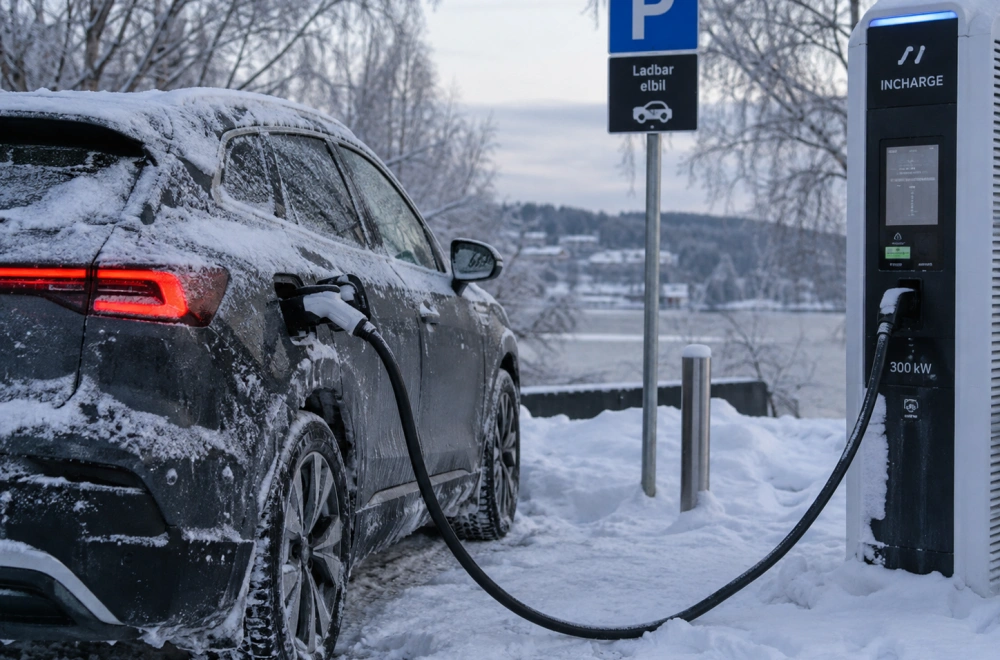
Several factors can result in range loss for Electric Vehicles in cold weather, but they happen at the same time. Battery efficiency decreases in low temperatures, whereas there is high energy consumption due to cabin heating, battery conditioning, high-speed driving, low tire pressure, and many short-distance rides.
There is no guarantee that range loss in winter will lead to irreversible harm to the battery. There are some ways to minimize the effect of cold weather on the vehicle. For instance, you can precondition the car, heat it properly, keep appropriate tire pressure, and plan charging stops.
0