

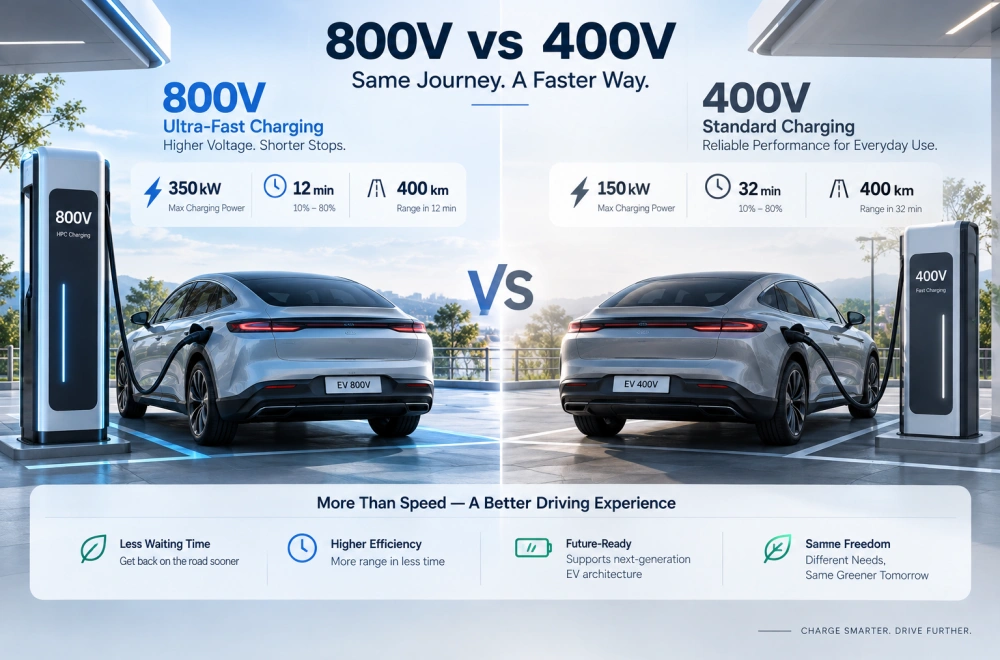
Due to the improved charging capacity of electric vehicles, the 800V EV Architecture is becoming more popular among new electric vehicles. The 800V EV Architecture is associated with higher charging capacity, lower heat dissipation, and greater efficiency compared to the traditional 400V architecture.
However, the 800V system may not always double the charging rate compared to the 400V system.
From the point of view of engineers, the key benefit of the high voltage is that it allows for a low current while transporting the same amount of power.
In this regard, the key to understanding the difference between the 800V and 400V architectures is their electrical basics.
1.800V vs 400V Platforms in Electric Vehicles: What is the Difference?
What Do 400V and 800V Actually Mean?
In the EV case, 400V or 800V refers to the approximate voltage level of the high-voltage electrical systems and not the exact voltage level that always stays consistent throughout.
In a standard high-voltage electrical system, there will be several components connected to one another: Battery Pack -> Inverter -> Electric Motor -> DC Fast Charging -> DC/DC Converter
The actual voltage of the battery varies depending on parameters such as the State of Charge (SOC), cell configuration, temperature, and the battery chemistry. Hence, an “800V EV” may not actually run on 800.0 volts.
The key point here is how the increased system voltage impacts the current needed for a particular amount of power.
Why Does Higher Voltage Reduce Current?
Electrical power may be described by the formula: P = V × I
where:
P = Power
V = Voltage
I = Current
For example, in an EV, there is a requirement to transmit 200 kW. Assuming ideal conditions, for a 400V system: 200,000 ÷ 400 = 500A
And for an 800V system: 200,000 ÷ 800 = 250A
Increasing the voltage level could lead to an almost 50 percent decrease in current levels
| Architecture | Power | Idealized Current |
| 400V | 100 kW | 250 A |
| 800V | 100 kW | 125 A |
| 400V | 200 kW | 500 A |
| 800V | 200 kW | 250 A |
| 400V | 300 kW | 750 A |
| 800V | 300 kW | 375 A |
These are basic calculations. In actual EVs, there are variations in battery voltage, conversion losses, resistance, and limitations due to power electronics.
However, the logic helps to understand the basic advantage of the 800V design – transferring the same amount of power using less current.
2. Why Lower Current Matters in 800V EV Architecture
Lower Current Can Reduce Resistive Losses
High amounts of current pass through wires, bus bars, connectors, and other high-voltage components when driving and fast charging.
Resistive energy loss can be calculated using the formula P_loss = I²R, where I represents current and R represents resistance. Assuming an equivalent wire resistance of 0.01Ω, a current of 500A produces 2,500W of resistive loss, while reducing the current to 250A lowers the loss to just 625W.
In this simplistic example, a decrease in current by 50% results in a reduction of the I²R loss by 75%, while resistance stays constant.
It does not mean that the 800V car would be 75% more efficient than the 400V car. There are differences in wire sizes, inverter losses, motor efficiency, semiconductors, etc.
The correct conclusion is that 800V system design offers engineering benefit due to reduced current in high-power applications.
Why Does Lower Current Matter for EV Design?
Increasing current places additional demands on:
• Cable cross-section
• Connectors
• Busbars
• Cooling systems
• Thermal management
A reduction in current provides engineers with the possibility to optimize for electrical losses and heat, especially when high power needs to be sustained within a car.
It should be noted that an 800V EV is not necessarily a smaller and easier-to-build system, since high voltages imply more stringent insulation and high-voltage devices.
3.Why Does 800V Architecture Improve EV Fast Charging?
Why Is 800V Suitable For Fast Charging At High Power?
Fast charging represents an area wherein the strengths of the 800V architecture can truly be seen.
If the DC fast charger has to provide 350 kW, then in an ideal calculation:
at 400V: 350,000 ÷ 400 = 875 A
at 800V: 350,000 ÷ 800 = 437.5 A
In order to supply 350 kW through a 400V power system, a very large amount of current will be required.
An increase in voltage enables the same amount of power to be transmitted with less current.
And that is the reason why high-power charging is becoming increasingly reliant on the following formula: High Voltage + Controlled Current = High Charging Power
Can an 800V Electric Vehicle Charge at Twice the Speed?
Number two: System voltage forms just one component of charging efficiency.
Actual charging speed depends on factors including:
• Charger output
• Battery temperature
• State of Charge
• Battery chemistry
• Battery capacity
• Charging curve
• Current limits
• Thermal management
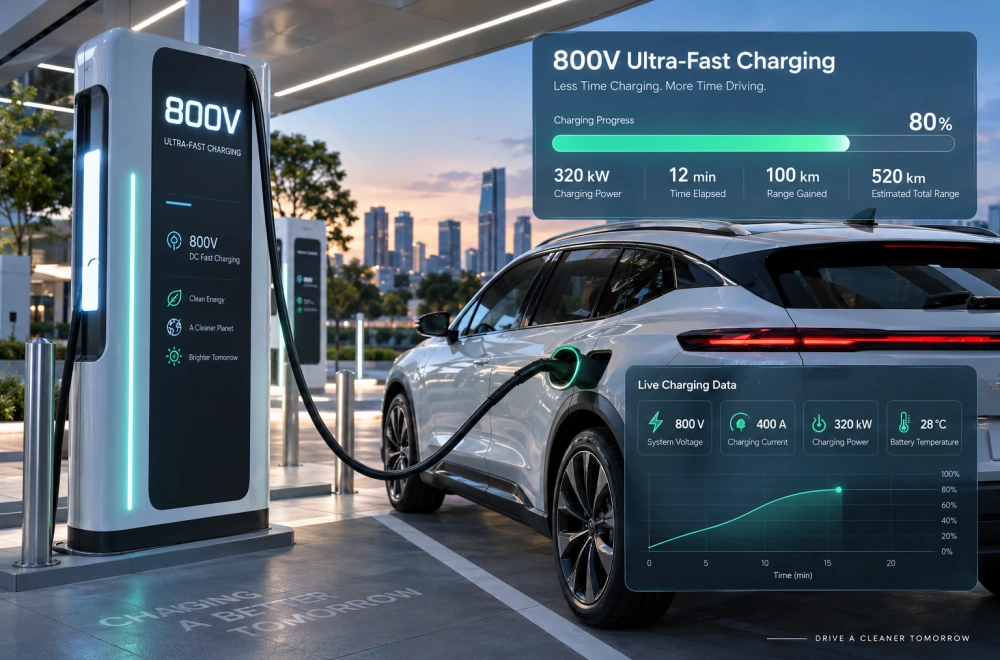
For instance, the charging power of 300 kW of an EV with 300 kW peak charging is not always maintained throughout the entire charging period.
The process of a standard fast charge is: Low State Of Charge (SOC) → High Charging Power → Increase In SOC → Decrease In Charging Power
In the case where the SOC rises, the BMS could lower charging power in order to control voltage and temperature.
As such, peak charging power can be misleading.
Other metrics to consider would be: 10-80% Charging Time + Average Charging Power + Charging Graph
Sometimes, E Vs with lower peak charging power yet flatter charging graphs finish their charging sessions at 10-80% faster than those with high peaks but short periods of time.
Can an 800V EV Use Lower-Voltage Chargers?
In many cases, definitely, although it depends on the design of the vehicle.
Some 800V cars have a boost converter or other power electronics components that can accept power coming from low-voltage DC chargers. In such cases, the charging rate will depend on: Charger Voltage + Current Limit + Vehicle’s Ability to Convert
An 800V charger rated at 350 kW doesn’t mean all 800V electric vehicles will charge at 350 kW.
Actual charging rate depends on the whole chain of devices: Charger → Power Electronics → Battery → BMS → Cooling System
Conclusion
The major distinction between 800V and 400V EV architectures is not only that 800V implies a higher voltage. Based on the P=V*I formula, higher voltage allows transferring the same amount of power with lower current. Since losses in the resistive circuit depend on I²R, lower current could be used to reduce electrical losses, control temperature, and increase charging power.
However, 800V doesn’t mean twice as fast charging, since battery temperature, its state of charge, charging curves, capabilities of the charger, and thermal management all affect the performance in practice.
The key point of 800V architecture lies in its potential rather than in voltage itself.
0