

There are many cars today that can follow other cars on the road automatically, remain within the lane, detect pedestrians, and even steer, accelerate, and brake at the same time. All these features could give the impression that the car is self-driving, but that does not make the car an autonomous one.
The key difference between ADAS (Advanced Driver Assistance Systems) and autonomous vehicles is not just the number of operations that the car can do. Rather, it is about who performs and controls the operation of driving.
In other words, ADAS helps the driver perform the driving task, while autonomous driving allows the vehicle to handle driving within specific conditions. This distinction is more useful than simply asking whether a vehicle can steer or brake on its own.
1. How Does ADAS Help Drivers on the Road?
ADAS Consists of Various Driver-Assistance Features
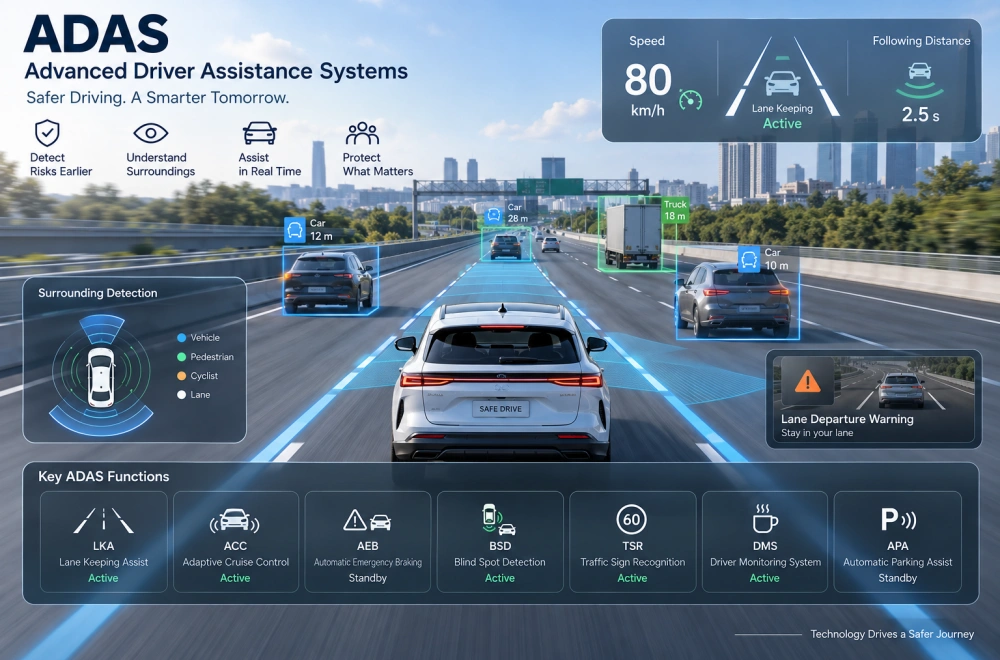
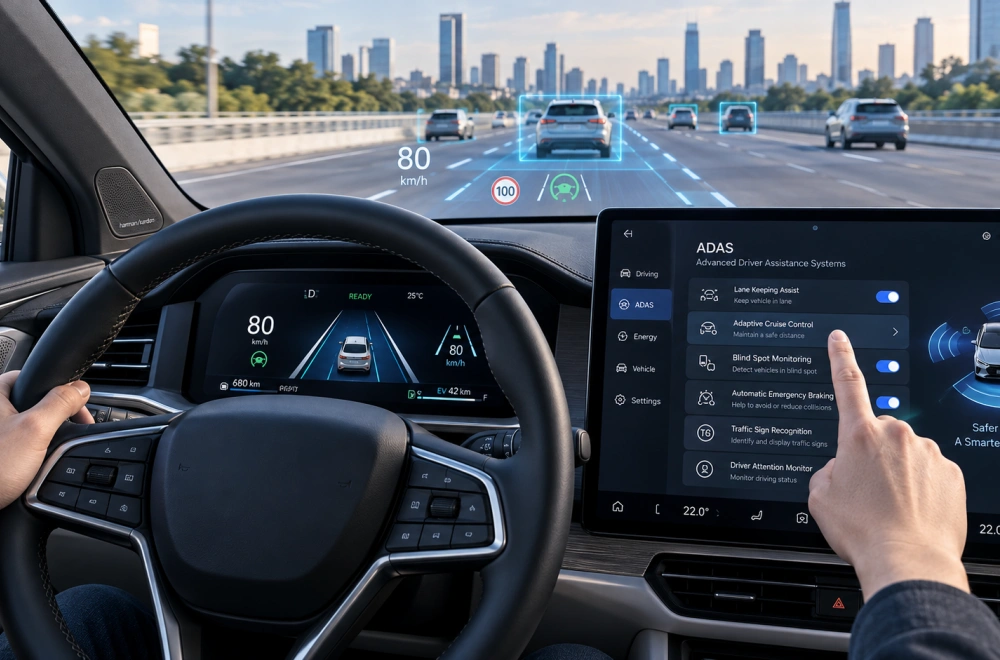
ADAS is not a single technology but refers to a collection of various technologies developed to assist drivers in minimizing some of the driving risks.
Typical ADAS technologies include:
• Adaptive Cruise Control (ACC)
• Automatic Emergency Braking (AEB)
• Lane Departure Warning (LDW)
• Lane Keeping Assist (LKA)
• Blind Spot Monitoring (BSM)
• Forward Collision Warning (FCW)
For instance, ACC may be able to change the speed of the car in order to keep a selected gap, whereas LKA may give steering assistance as the car approaches lane lines.
However, these technologies may also be able to take control over the operation of the car, but:
Vehicle Control ≠ Driving Control
How Does ADAS See the Road?
ADAS relies on sensors to gather information about the surrounding environment.
| Sensor | Main Function | Typical Strength |
| Camera | Lanes, signs, object recognition | Rich visual information |
| Radar | Distance and relative speed | Motion detection |
| LiDAR | 3D environmental measurement | Spatial structure |
| Ultrasonic | Short-range detection | Parking and low-speed use |
The camera will tell whether an obstacle ahead is a pedestrian or another car, while the radar will provide information on its distance and speed.
Modern systems, thus, have to not only answer the question of “what” but also:
• Where is it?
• How is it moving?
• Am I at risk of colliding with it?
Autonomous Driving Goes Beyond Detection
Advanced autonomous driving will involve a more comprehensive approach to decision-making: Perception → Localization → Prediction → Planning → Control
Let’s assume that the system detects a pedestrian 20 meters away. The detection of the pedestrian is just one part of the entire process. The car might have to perform predictions about whether the pedestrian will cross the road, check whether it has enough space to stop, decide how to respond, and issue commands to brake or steer.
A full driving cycle is the key distinction of advanced autonomy from basic assistance systems.
2. ADAS vs Autonomous Cars: What Is the Difference Explained Through SAE Levels?
SAE Levels Focus on Driving Responsibility
The SAE driving automation framework ranges from Level 0 to Level 5.
| SAE Level | Automation | Who Performs/Monitors Driving? |
| Level 0 | No Driving Automation | Driver |
| Level 1 | Driver Assistance | Driver |
| Level 2 | Partial Automation | Driver |
| Level 3 | Conditional Automation | System under defined conditions |
| Level 4 | High Automation | System within its ODD |
| Level 5 | Full Automation | System |
From Levels 0 to 2, the driver is still accountable for monitoring the driving task.
From Level 3 onwards, the system is able to perform the DDT under the conditions set by that level and the system.
Why Is Level 2 Often Confused With Autonomous Driving?
Level 2 systems are able to manage:
Steering + Acceleration + Braking
On the freeway, for instance, the vehicle will keep a constant speed, track the preceding car, and stay centered within the lane.
From inside the car, the operation seems very much automatic. Nonetheless, the driver should still monitor the driving context and be prepared to take over.
The following difference is then very clear: Hands-Free ≠ Eyes-Free
The mere presence or absence of hands on the steering wheel does not necessarily imply autonomy.
Why Is Level 3 an Important Transition?
Level 3 is referred to as Conditional Driving Automation.
The system carries out the entire DDT under certain conditions. But the driver will still have to take action in case there is a need to take over from the system.
This can be summarized as follows:
Level 2 – The driver continually monitors
Level 3 – The system carries out the driving task under specific conditions
The transition from Level 2 to Level 3 will thus not just involve adding an extra camera or sensor. It will require changes in architecture and many other factors.
Why Is Level 4 Often Associated With Robotaxis?
Level 4 ADAS would be able to execute the driving task within a certain Operational Design Domain (ODD) without needing the assistance of the driver in real time.
The Operational Design Domain (ODD):
• Geographic area; type of road
• Speed range
• Weather
• Time of day
• Traffic conditions
Thus, a Level 4 Robotaxi that is operating within a mapped urban region may not be designed to travel in an unmapped mountain area or even during snowstorms.
In simple terms: Driverless does not mean Unlimited Driving
3. ADAS vs Autonomous Driving: Who Is Responsible for Driving?
The Driver Remains Critical in ADAS
As far as Level 1–2 ADAS goes, the vehicle could help with such tasks as controlling speed, handling, braking, and hazard monitoring, yet the driver would still be in charge of keeping an eye on the road.
If there are problems recognizing lane markings owing to snow, glare, or bad road conditions by the means of a camera, the system could:
Generate Warning – Decrease Assistance – Give Control Back to the Driver
This is the reason why more sophisticated ACC, AEB, and Lane Keeping Assist will never make your vehicle drive on its own.
Autonomous Driving Requires More Complex Failure Management
As the automated system now becomes responsible for the driver’s task, it is also necessary to think about what will happen when things go wrong.
Challenges may include:
• Blocked sensors
• Missing lane markings
• Temporary construction
• Emergency vehicles
• Malfunctioning traffic lights
• Hardware or software faults
For systems with a higher level of automation, the system should be able to detect faults and respond with the correct behavior.
For a level 4 system that is unable to safely proceed further, it might have to achieve a Minimal Risk Condition as follows:
Detect Faults → Assess Risk → Slow Down → Identify Safe Location → Halt
This capability is just as important as regular steering and braking.
Automation Cannot Ignore Physics
Even state-of-the-art systems are constrained by the physics of vehicle dynamics.
For instance, at 100 km/h, a car can cover approximately: 27.8 meters per second
This implies that it takes only one second to travel 27.8 meters before taking into account the extra distance needed for braking.
Stopping capability will depend on: Vehicle Speed + Tire Grip + Road + Weather + Brakes
The ability of ADAS and autonomous driving systems to perceive a threat earlier does not change these physical constraints.
Conclusion
What sets apart ADAS from Autonomous Driving is not the number of cameras, sensors, and control systems that come with a vehicle, but rather who is liable for the task of driving.
In the case of ADAS, the driver plays an essential role at SAE Levels 0-2, whereas with higher levels of automation, these aspects are gradually shifted to the system itself.
0