

At the core of this global connectivity infrastructure is the fiber optic drop cable, a key component in fiber-to-the-home (FTTH) and fiber-to-the-building (FTTB) networks. Its primary role is to deliver high-speed data directly from the main distribution network to end users with minimal signal loss. Unlike traditional copper cables that rely on electrical signals, fiber optic technology uses light to transmit data, enabling significantly faster speeds and greater bandwidth capacity. Understanding how a fiber optic drop cable supports high-speed data transmission helps explain why it has become the backbone of modern communication systems.
Light-Based Transmission for Maximum Speed
The fundamental reason a fiber optic drop cable can support high-speed data transmission lies in its use of light signals instead of electrical signals.
- Optical signal transmission: Data is converted into light pulses that travel through glass fibers at extremely high speeds, close to the speed of light.
- Minimal signal resistance: Unlike copper wires, fiber optics does not suffer from electrical resistance, allowing faster and more efficient data flow.
- Long-distance stability: Light signals maintain integrity over longer distances without significant degradation.
- High-frequency capacity:Optical fibers can carry far more data simultaneously compared to traditional cables.
This light-based transmission system is the foundation of ultra-fast internet connectivity in modern networks.
High Bandwidth Capacity and Data Handling Efficiency
Another key advantage of a fiber optic drop cable is its ability to handle large volumes of data simultaneously, making it ideal for high-demand environments.
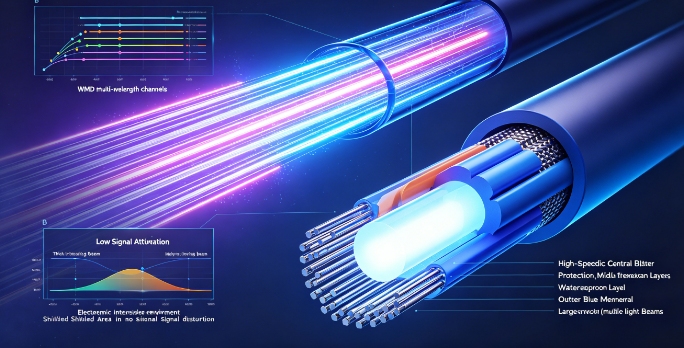
- Multi-channel data transmission: A single fiber can carry multiple wavelengths of light using WDM (Wavelength Division Multiplexing) technology.
- Support for heavy internet usage: Ideal for streaming, gaming, cloud computing, and enterprise-level applications.
- Low congestion performance: Even under heavy network load, fiber maintains stable performance without major slowdowns.
- Scalable infrastructure support: Easily supports future upgrades without requiring major physical changes to the network.
This high bandwidth capacity ensures smooth and efficient data transmission for both personal and business users.
Low Signal Loss and High Transmission Efficiency
One of the most critical factors in high-speed communication is signal integrity, and a fiber optic drop cable excels in maintaining low signal loss.
- Minimal attenuation: Optical fibers experience very low signal weakening over distance compared to copper cables.
- Reduced electromagnetic interference: Fiber is immune to EMI (Electromagnetic Interference), ensuring stable data transmission.
- Cleaner signal quality: Light-based transmission avoids noise and distortion common in electrical systems.
- Consistent performance in complex environments: Works reliably even in areas with high electrical activity.
These characteristics ensure that data arrives accurately and quickly, even in challenging installation environments.
Structural Design Supporting High-Speed Performance
The physical construction of a fiber optic drop cable also plays a crucial role in ensuring high-speed and stable data transmission.
Core Fiber Technology
- High-purity glass fibers enable faster light transmission.
- Precise core alignment reduces signal distortion.
Protective Layers
- Outer jackets protect against environmental damage.
- Water-blocking materials prevent moisture interference.
Reinforcement Components
- Steel wires or FRP elements enhance durability during installation.
- Bend-resistant designs maintain signal quality in tight spaces.
Together, these structural elements ensure consistent high-speed performance even under physical stress.
Installation Quality and Network Optimization
Even the most advanced fiber optic drop cable requires proper installation and network design to achieve optimal high-speed performance.
- Correct bending radius management: Prevents micro-cracks and signal degradation in fibers.
- Professional connector termination: Ensures minimal insertion loss at connection points.
- Proper routing design: Reduces physical stress and improves long-term stability.
- Network equipment compatibility: Works best when paired with high-quality routers, switches, and optical terminals.
Good installation practices ensure that the cable operates at its full transmission potential.
Conclusion
In conclusion, a fiber optic drop cable supports high-speed data transmission through its use of light-based signaling, high bandwidth capacity, low signal loss, and advanced structural design. Its ability to transmit data at near-light speed while maintaining stability over long distances makes it a superior solution compared to traditional copper-based systems. Combined with proper installation and network optimization, it ensures reliable, high-performance connectivity for modern digital applications. As global data demands continue to rise, fiber optic drop cables will remain a critical foundation for delivering fast, efficient, and future-ready communication networks.
0