

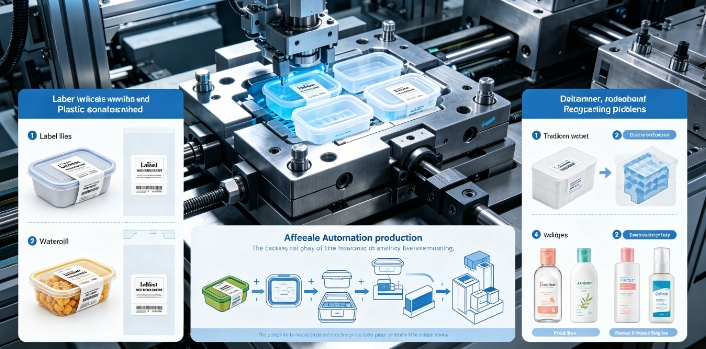
In the modern packaging industry, manufacturers must simultaneously enhance product quality, reduce costs, strengthen brand image, and meet environmental requirements. Traditional labeling methods often struggle to balance these needs, especially in large-scale production. In mold labeling offers an efficient solution by directly integrating labels into plastic products during the injection molding process. This approach helps eliminate many issues found in post-molding labeling and has become an important innovation across food packaging, cosmetics, and household product industries.
Eliminating Label Peeling and Surface Damage Issues
One of the most common problems in traditional packaging is label deterioration over time. Adhesive labels are often exposed to moisture, friction, and temperature changes, which can lead to peeling, fading, or bubbling. In mold labeling addresses these problems by permanently integrating the label into the product surface.
Key improvements include:
- The label becomes part of the plastic structure, preventing peeling during transportation or usage.
- Moisture and condensation have no effect on label adhesion, making it suitable for refrigerated and frozen products.
- Scratch resistance is significantly improved, protecting branding information throughout the product lifecycle.
- The printed surface is better protected against damage from oil, chemicals, and cleaning agents.
Because the label is no longer an external layer, product appearance remains stable and professional even under harsh conditions.
Solving Inefficiencies in Multi-Step Production Processes
Traditional labeling systems require multiple production stages, including container molding, cooling, labeling, inspection, and packaging. These separate steps often increase labor costs and production time. In-mold labeling streamlines production by combining molding and decoration into one integrated step.
Efficiency improvements include:
- Label placement occurs inside the mold before injection, eliminating post-production labeling.
- Automated systems reduce the need for manual handling and lower human error rates.
- Shorter production cycles allow large-scale manufacturing to reach higher output levels.
- Lower equipment demand makes factory layout more streamlined and maintenance easier to manage.
This integrated approach significantly improves operational efficiency while reducing overall manufacturing complexity.
Improving Branding Consistency and Visual Quality Problems
Inconsistent labeling is another challenge faced by many manufacturers using traditional methods. Misaligned stickers, air bubbles, and uneven placement can all negatively impact a brand’s image. In mold labeling ensures consistent and high-quality visual results across all products.
Key advantages include:
- High-resolution printing allows precise reproduction of logos, text, and graphics.
- Labels are fixed in position during molding, preventing misalignment or shifting.
- Seamless surface integration eliminates visible edges or wrinkles.
- Full-surface decoration enables 360-degree branding opportunities.
This consistency helps companies maintain a professional image and strengthen brand recognition in competitive retail environments.
Reducing Environmental and Material Waste Challenges
Sustainability is now a major priority in global manufacturing. Many conventional labeling methods depend on adhesives, backing paper, and other supporting materials, which leads to higher levels of waste.
In mold labeling helps reduce these environmental impacts.
- No separate adhesive layers are required, reducing chemical usage in production.
- Labels and container materials can often be recycled together more conveniently.
- Fewer production steps lead to lower energy consumption.
- Reduced scrap and defective rates minimize material waste.
These benefits support eco-friendly manufacturing practices and align with global sustainability goals.
Addressing Cost Pressure in Large-Scale Production
Manufacturers often face the challenge of balancing high-quality packaging with cost efficiency. While advanced labeling systems may require an initial investment, in mold labeling helps reduce long-term operational costs.
Cost-saving factors include:
- Lower labor costs due to automation and reduced manual processes.
- Decreased defect rates reduce rework and material waste expenses.
- Faster production cycles increase output efficiency per machine.
- Reduced need for secondary labeling equipment lowers maintenance costs.
Although initial setup costs may be high, its long-term economic benefits make it highly attractive for large-scale production environments.
Conclusion
In summary, in mold labeling effectively solves multiple challenges in modern packaging production, including label durability issues, inefficient multi-step processes, inconsistent branding, environmental concerns, and long-term production costs. By integrating labeling directly into the molding process, manufacturers can achieve higher efficiency, improved visual quality, and more sustainable operations. As packaging demands continue to grow across industries, in mold labeling is becoming a key solution for overcoming traditional manufacturing limitations and supporting advanced product design and branding strategies.
0