

Galvanized anchor rods are used when it comes to foundations, steel connections, and slope stabilizations among others. This is because the purpose of the anchor rods is to transmit a load to concrete, soil, or rock while, at the same time, protecting the steel from corrosion through galvanization.
Anchor rods also vary greatly when it comes to their installation and design. Concrete foundations may be installed with either cast-in-place or post-installed anchor rods, while ground support projects may need self-drilling anchor rods.
1. What Are the Main Applications of Galvanized Anchor Rods?
Applications of galvanized anchor rods vary with the type of soil, loads, and type of installation.
1.1 How Are Galvanized Anchor Rods Used in Building Foundations?
Steel structures use galvanized anchor rods to connect column base plates to concrete foundations. Industrial buildings, warehouses, and platform structures transmit tensile, shear, and overturning forces via connections from the structural system to the foundation. The rods are embedded into the structure before the casting of concrete, which happens when the structure gets enough concrete strength. Several parameters should be considered in the connection design, such as rod diameter, steel grade, embedment length, and concrete strength. For example, the minimum yield strengths of 36, 55, and 105 ksi are set by ASTM F1554 for Grades 36, 55, and 105, respectively. Steel strength is not the only connection strength parameter.
1.2 Why Are Galvanized Anchor Rods Used in Slope Stabilization?
Slopes can become unstable due to reasons such as excavation, rainwater, fluctuations in the groundwater table, and even poor geologic conditions. Anchor rods help stabilize the slopes through transferring the forces to the stable soils or rocks and hence limiting their movement. They become very useful, especially when there are certain types of fractures in the rock formations. The hollow threads make them very easy to drill and install at the same time.
A typical example is ONTONBOLT’s HDG Coating Self-drilling Anchor Rods. These rods combine a self-drilling design with hot-dip galvanized protection and are used in slope stabilization, retaining wall support, and related ground reinforcement applications. The hollow structure supports drilling and grouting, while the zinc coating provides additional corrosion protection. Actual anchor length, spacing, and inclination must be determined from ground conditions and engineering requirements.
1.3 How Are Galvanized Anchor Rods Used in Retaining Walls?
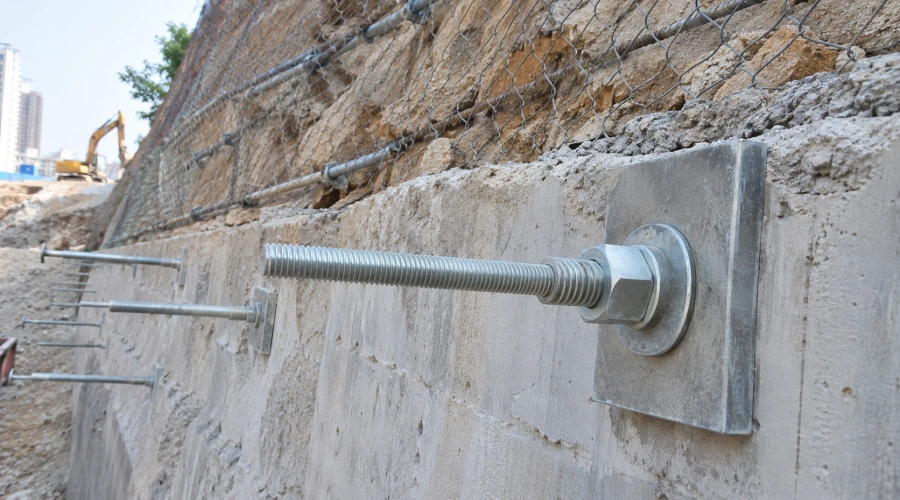
Retaining walls are used to prevent the effects of the pressure created by the earth behind the wall. In cases where the soil is not sufficient to provide proper support to the wall, it is necessary to use an anchor that will help to share the load with better soil.
It all depends on the design of the system, since the system could use either prestressed earth anchors or soil nails, among other options. The prestressed anchors make sure that there is some initial tension, whereas the soil nails withstand deformations in the soil. The spacing, inclination, and length of the anchors are dependent on the earth pressure, water, and allowable displacement of the wall.
1.4 Where Are Galvanized Anchor Rods Used in Infrastructure Projects?
Galvanized anchor rods also serve transportation, industrial, and energy infrastructure.
Transportation Facilities
The steel plate foundations are bolted to the concrete foundation through galvanized anchor rods for some road signs, light posts, and other roadside structures.
Industrial Equipment
Machinery foundations, steel mounting frames, and equipment platforms may require anchors to resist operating loads and restrict movement.
Energy Infrastructure
Corrosion protection of the anchorages is used for outdoor steel support systems, utility equipment platform structures, and some power structures. In each case, various needs are present. Equipment structures experience vibration loading, while structural supports face exposure to the environment over time.
2. Why Are Galvanized Anchor Rods Preferred for Outdoor Applications?
The outdoor anchoring components will be subjected to rain, humidity, and temperature changes. The process of galvanization minimizes the exposure of the steel to corrosive conditions and is therefore applicable in numerous applications.
2.1 How Does Galvanizing Improve Durability in Outdoor Environments?
Two methods of protecting steel with zinc coating are available.
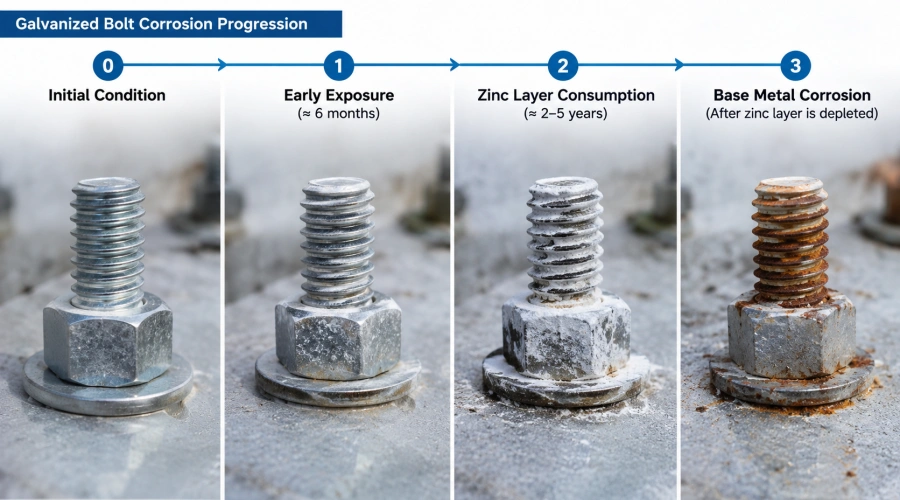
The zinc coating serves as a barrier for water and oxygen. Second, the zinc coating can serve as sacrificial protection for other steel structures that are exposed in case of any damage to the coating. Normally, the zinc coating from hot-dip galvanization is sufficient for outdoor steel structures.
Nevertheless, galvanization does not protect from corrosion indefinitely. Zinc gets worn out, and its lifetime depends on coating properties and environment. According to ISO 9223, the corrosivity of the atmosphere is divided into six classes: C1 (very low), C2 (low), C3 (medium), C4 (high), C5M (very high marine atmosphere), C5I (very high industrial atmosphere), and CX (extreme).
2.2 What Environmental Conditions Affect the Selection of Galvanized Anchor Rods?
Corrosion conditions vary significantly between installation environments.
| Environment | Main Corrosion Factors | Selection Considerations |
| General outdoor | Rainfall, humidity, temperature changes | Coating quality and exposure |
| Coastal | Salt deposits and chlorides | Increased corrosion risk |
| Industrial | Airborne pollutants and moisture | Atmospheric corrosivity |
| Underground | Soil pH, moisture, electrical resistivity | Soil assessment and long-term protection |
Hot-dip galvanizing may be a suitable process for many outdoor applications, although more corrosion resistance may be required in very corrosive environments like coastal regions or industrial sites. For buried anchors, corrosion is influenced by soil composition, groundwater, and moisture content in the soil.
2.3 What Should Be Considered When Choosing Galvanized Anchor Rods?
The selection of the anchors should not be based solely on the dimensional requirements and the appearance of the anchors.
• Supporting facts: The installation methods of anchors for concrete, soil, and rock are quite different.
• Loads: The type of loads to be used, that is, tensile loads, shear loads, vibratory loads, and cyclic loads, among others, is another critical consideration.
• Installation methods: They can be cast-in-place anchors, post-installed anchors, or self-drilling anchors.
• Atmospheric conditions: The atmospheric conditions in which the anchors would be installed will have an impact too.
Concrete column base anchors transfer the loads through the interaction between the anchors and the foundation. The same case applies to self-drilling ground anchors since the load is transferred through the interaction between the steel, the grout, and the ground.
Conclusion
The galvanized anchor bolts could serve in anchoring foundations, making connections of steel, stabilizing slopes, retaining walls, and other constructions. The galvanized anchor bolts would serve as anchors structurally and decrease the effects of corrosion because of their zinc coating. The selection of the correct design will depend on the purpose of the bolt. In concrete connections, the capacity of the anchorage requires an important assessment, and in the same way, the geology and grouting influence the design of the ground support system.
0