


The first major advantage of Hybrid Cars is that it is possible to reduce fuel use without relying on charging networks. The use of an internal combustion engine and electric motors allows the car to regulate energy output depending on speed, battery charge, and road conditions.
However, it would be wrong to say that Hybrid Cars are always more efficient in fuel use than ordinary gasoline cars. The only reason why Hybrid Cars are better here is less energy waste while driving.
Generally speaking, efficiency depends on: Powertrain Efficiency + Road Conditions + Car Weight + Temperature + Driving Habits
1. Why Are Hybrid Cars More Fuel-Efficient?
Electric Motors Improve Unproductive Engine Performance
The gasoline engine is the primary power generator in the conventional gasoline vehicle; however, the efficiency of the engine is not always the same at all speeds and loads.
Driving off idle, slow driving, and frequent acceleration will put the engine into its less efficient mode of operation.
The use of the electric motor may solve this problem for Hybrid Cars. The motor produces instant torque at start, and it assists in the acceleration process.
At constant speed, the hybrid system can control how much work each generator has to do. The point here is not merely adding an electric motor, but rather maintaining the engine in the efficient mode of operation wherever possible.
Regenerative Braking Recovers Energy
In a standard car, the majority of the vehicle’s kinetic energy becomes heat energy through the use of the brakes during the slowing of the vehicle: Kinetic Energy → Brake Heat → Wasted Energy
Hybrid Cars, on the other hand, have the ability to recover some of this energy using regenerative braking: Kinetic Energy → Motor/Generator → Electrical Energy → Battery
The kinetic energy of the vehicle can be calculated using: KE = ½mv²
A vehicle weighing 1,600 kilograms moving at 50 km/h (13.9 m/s) contains around: 0.5 × 1,600 × 13.9² ≈ 155 kJ
kinetic energy, which is equal to 0.043 kWh of energy.
Not all of this energy can be recovered by a hybrid car, as there will be losses throughout the process in terms of the motor, inverter, battery, and mechanical systems. But the advantages come when this cycle repeats itself: Accelerate → Brakes → Recovery → Repeat
It is particularly efficient in traffic that stops and starts.
Engine Stop/Start Reduces Unnecessary Fuel Use
Although the car is stationary at the traffic lights with zero kilometers per hour, a running internal combustion engine uses fuel.
Hybrid Cars turn off the engine whenever there is a possibility and employ the battery to provide energy for some of the systems.
This means that fuel economy is provided not only by electricity but also by the absence of unnecessary work of the engine.
2. Which Setting is More Fuel Efficient for Hybrid Vehicles?
City Driving Often Favors Hybrid Technology
Traffic in cities usually includes: acceleration → braking → stopping → restarting
This is an inefficient process for most regular gasoline cars but offers many chances to utilize regenerative braking, electric power assistance, and the motor-off process for hybrid cars.
Thus, for some Hybrid Cars, one can have: city miles per gallon ≥ highway miles per gallon
This is not the case with most regular gasoline cars, which perform better on highways rather than in stop-and-go traffic.
Nevertheless, it doesn’t apply to all hybrid cars.
Why Is There Less Hybrid Advantage on the Highway?
Highway driving typically involves: Greater Speed + More Constant-Speed Driving + Less Brake Use
Less frequent braking reduces the number of chances for regenerative braking. In constant high-speed driving, the engine might also play a greater role in providing the necessary energy.
Air resistance plays an increasing role as speed increases. The basic equation for air resistance is: Fd = ½ρCdAv²
Since speed is squared in this equation, an increase in speed makes a considerable difference to air resistance.
Consider just the effect of speed: 120² ÷ 80² = 2.25
At the same other conditions, air resistance at 120 km/h is roughly 2.25 times air resistance at 80 km/h.
It is not possible for hybrid systems to change this basic law of physics.
How Should You Compare MPG?
Fuel economy in the United States is commonly measured in MPG, while many other markets use L/100 km.
| MPG (US) | Approx. L/100 km | Fuel Use |
| 30 | 7.8 | Higher |
| 40 | 5.9 | Moderate |
| 50 | 4.7 | Lower |
| 60 | 3.9 | Very Low |
Conversion formula: L/100 km = 235.2 / MPG (US)
More MPG means more efficient use of fuel, whereas less L/100 km indicates less fuel used.
Official figures are great to compare with, but they are by no means guaranteed fuel efficiency in reality.
3.Fuel Efficiency of Hybrid Cars: Comparison with Conventional Cars
Real Fuel Savings Depend on How You Drive
Consider two similar vehicles:
• Gas car: 0 L/100 km
• Hybrid car: 0 L/100 km
• Annual distance: 15,000 km
The gasoline car would theoretically consume: 15,000 ÷ 100 × 8 = 1,200 liters/year
The hybrid would use: 15,000 ÷ 100 × 5 = 750 liters/year
The difference is 450 liters per year.
At a fuel price of $1.20/L, that would equal: 450 × $1.20 = $540/year
This is only an example. Actual savings depend on the specific vehicles, fuel prices, traffic, mileage, and driving habits.
Weather and Driving Style Change Fuel Economy
Cold weather causes more engine warming and impacts the hybrid battery, regenerative braking, and tire pressure. Aggressive acceleration increases power demand. If the electric motor cannot provide sufficient power efficiently on its own, then the engine is used more often.
Simplified explanation: Hard Acceleration → High Power Demand → Engine Use Increases → Increased Fuel Consumption
The reason for that is: Rated MPG ≠ Guaranteed Real-World MPG
All Hybrid Cars Are Not Built the Same
A mild hybrid relies on its electrical system to assist the engine in its operation while having little electric-only operation.
A full hybrid is able to travel short distances or move slowly through its electric drive system when appropriate conditions prevail.
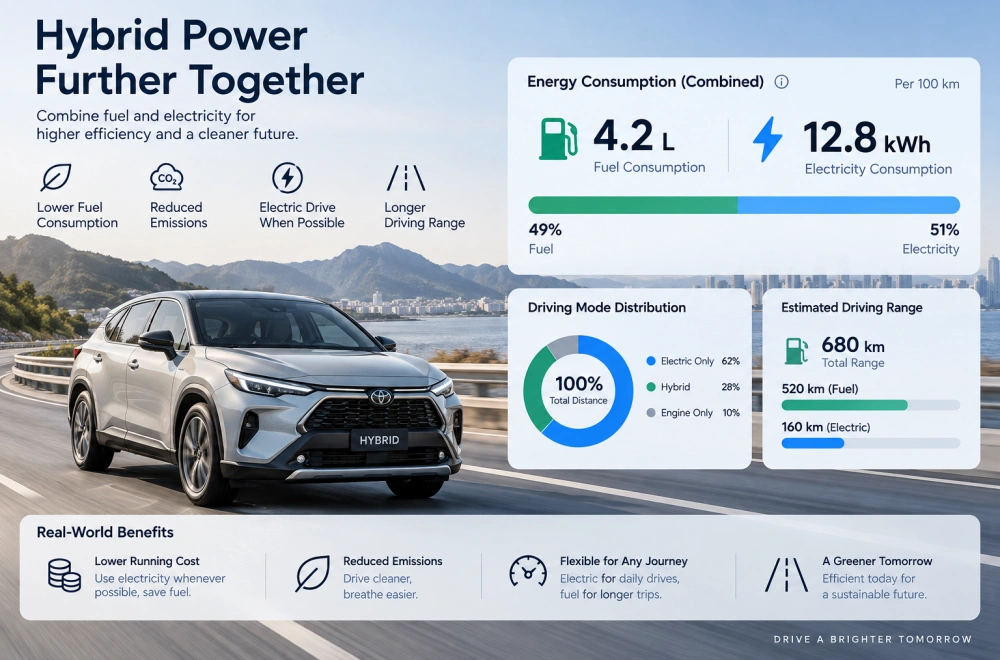
A plug-in hybrid has a bigger battery pack than that found in standard hybrids, which can be charged separately. Fuel consumption by a plug-in hybrid is highly dependent on: Frequency of Charging + Distance Travelled Daily + Electric Range
A plug-in hybrid that is often charged and travels short distances will make less use of its engine than a similar vehicle that does not get charged regularly.
Efficiency benefits of Hybrid Cars become evident especially in urban commutes, moderate-speed traveling, frequent braking, and gradual acceleration. The efficiency benefit might be lower under conditions of high-speed driving, cold weather, aggressive acceleration, or heavy loads.
Conclusion
Fuel savings may be achieved by hybrid vehicles via electric drive, regenerative braking, engine shut-off, and other mechanisms of enhanced energy management. Yet the magnitude of the advantage is highly dependent on driving conditions.
Stop-and-go driving in urban areas usually maximizes the efficiency of hybrid technology, whereas higher-speed driving and challenging circumstances tend to make the gap between the two types narrower. Rather than making any assumptions about the superior efficiency of hybrid cars, compare MPG, type of hybrid, annual mileage, and driving conditions to determine your personal fuel savings potential.
0