


The Variegated Ficus is a striking ornamental plant known for its decorative leaves that combine green tones with creamy white or yellow patterns. Because of its elegant appearance and high demand in the indoor plant market, many plant enthusiasts often ask whether the Variegated Ficus is truly rare. In reality, its rarity is not absolute. Some types are widely cultivated and easy to find, while others with stable and high-contrast variegation can be relatively uncommon. The rarity depends on genetics, propagation success, and market availability rather than a single fixed condition.
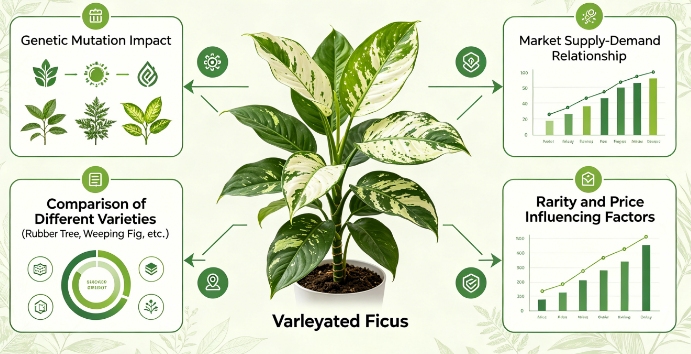
1. Genetic factors that affect rarity
The rarity of a Variegated Ficus is strongly influenced by its genetic structure, which determines whether variegation appears and remains stable over time.
- Chlorophyll mutation instability:
Variegation is caused by natural genetic mutations, which result in a localized reduction of chlorophyll in the leaves. Because this mutation is unstable, not all new plants will maintain the same pattern, making consistent specimens harder to produce. - Reversion to green leaves:
Some plants may gradually lose their variegation and produce fully green leaves, especially under low light conditions. This reduces the number of visually appealing plants available in the market. - Selective propagation limitations:
Growers must carefully select cuttings from stable mother plants. Even then, not all propagated plants retain the desired pattern, increasing waste and limiting supply. - Natural variation uniqueness:
Each plant shows slightly different patterns, meaning highly symmetrical or balanced variegation is naturally less common.
2. Market supply and cultivation influence
The availability of a Variegated Ficus in the market is also shaped by how it is cultivated and distributed globally.
- Mass production reduces rarity:
Large commercial nurseries can propagate common varieties efficiently, making some types widely available and no longer rare. - Boutique plant cultivation:
Smaller growers often focus on premium specimens with stable variegation, but their limited production keeps supply low. - Regional distribution differences:
In some regions, variegated plants are widely sold in garden centers, while in others they are considered imported specialty items. - Market trend fluctuations:
When indoor plant trends rise, demand increases quickly, temporarily making certain types harder to find.
3. Types of variegated Ficus and their availability
Different varieties show different levels of scarcity, and not all Variegated Ficus plants are equally rare.
- Ficus elastica variegata (common rubber plant type):
This is the most widely available form and is generally not considered rare due to large-scale propagation. - Ficus benjamina variegata (weeping fig type):
Moderately available, but more sensitive to environmental stress, which limits stable production in some climates. - Ficus lyrata variegata (rare ornamental form):
Much harder to find due to slow growth and difficulty maintaining stable variegation, making it more valuable among collectors. - Collector-selected cultivars:
Plants with high-contrast, evenly distributed patterns are often sold at premium prices and are considered rare within niche markets.
4. Factors that increase perceived rarity and price
Even when a Variegated Ficus is not biologically rare, several external factors can make it appear rare in the market.
- Slow growth rate:
Variegated plants generally grow more slowly because reduced chlorophyll limits photosynthesis efficiency, increasing production time. - High demand from interior design trends:
Designers and plant collectors prefer visually unique foliage, pushing demand higher than supply in some periods. - Propagation success rate limitations:
Not all cuttings survive or maintain variegation, reducing the number of saleable plants. - Aesthetic quality grading:
Plants with balanced leaf patterns are graded higher and priced accordingly, making top-quality specimens feel rare.
Conclusion
So, is the Variegated Ficus rare? The answer depends on the specific type and quality of the plant. Common varieties are widely available and not rare, while stable, high-contrast, and well-formed specimens can be relatively uncommon and highly valued. Its rarity is influenced more by propagation difficulty, market demand, and visual quality than by the plant itself. Overall, the Variegated Ficus should be seen as a plant with varying levels of rarity rather than a universally rare species.
0